Yves Wagner · 20 October 2026
Documenting the Evolution of Silk Production Through Non-Destructive Labeling Methods in Historical Textile Archives
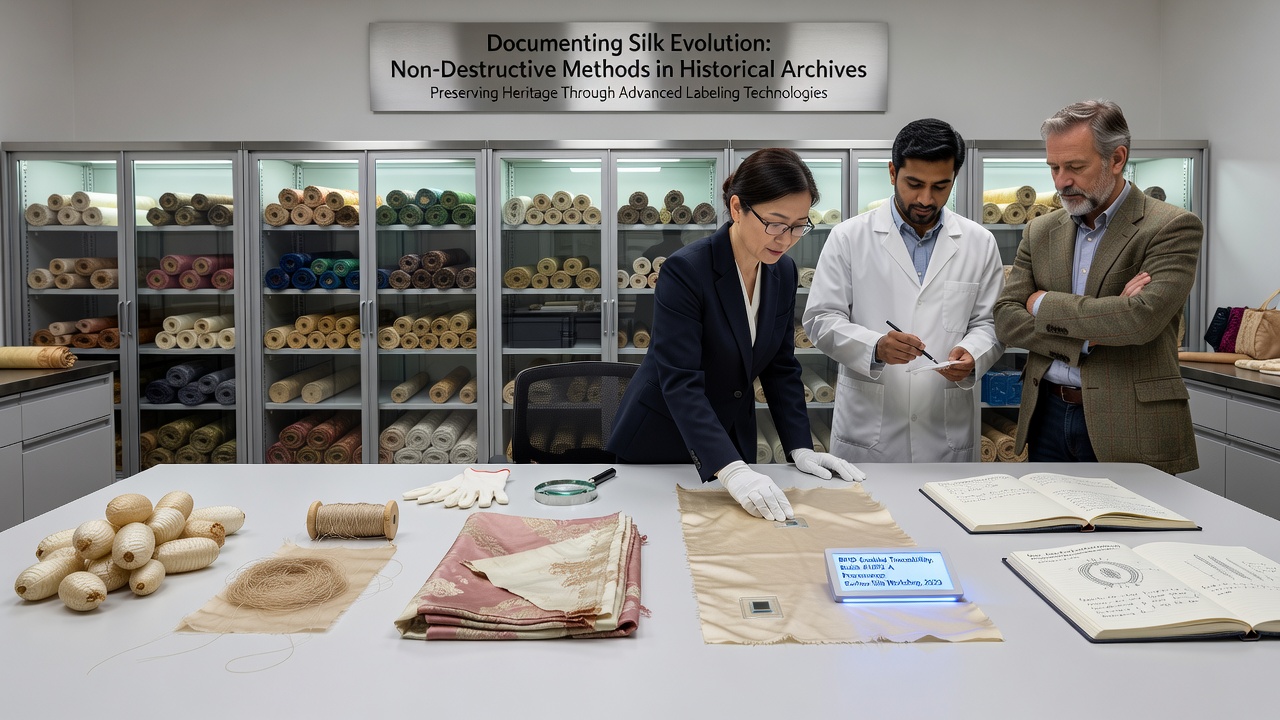
Archivists and textile researchers have tracked the progression of silk manufacturing from ancient hand-reeling practices in East Asia to mechanized production systems in later centuries, and non-destructive labeling methods now allow detailed documentation without altering fragile fibers or dyes. These approaches preserve original material integrity while recording production details such as thread count, dye composition, and regional weaving patterns that distinguish early Chinese techniques from subsequent European adaptations.
Early Silk Production Records and Initial Labeling Approaches
Historical archives contain examples of silk dating back over two thousand years, with production centers in China developing sericulture methods that spread along trade routes to India and the Mediterranean by the first century CE. Early documentation relied on attached paper tags or woven inscriptions that often required physical attachment points, yet researchers have identified cases where these methods caused fiber stress over time. Data from museum collections shows that by the fourteenth century, Italian workshops in Lucca and Venice incorporated guild marks directly into selvedges, creating permanent yet non-invasive identifiers that survived multiple handling cycles.
Archival studies reveal that Japanese textile collections from the Edo period employed subtle embroidery knots as markers, allowing curators to trace specific looms without additional attachments. These techniques evolved alongside production advances, including the shift from manual spinning to water-powered throwing machines in eighteenth-century England, where production logs began referencing fiber samples stored separately from finished bolts.
Transition to Non-Destructive Identification Systems
Modern conservation protocols emphasize methods that avoid abrasion or chemical exposure, and institutions now apply techniques such as micro-ink printing visible only under ultraviolet light alongside digital imaging for pattern recognition. Research from the Smithsonian Institution indicates that these systems enable tracking of silk samples across multiple archives without compromising structural integrity, while data from European collections demonstrates improved accuracy in dating pieces through embedded spectral markers.
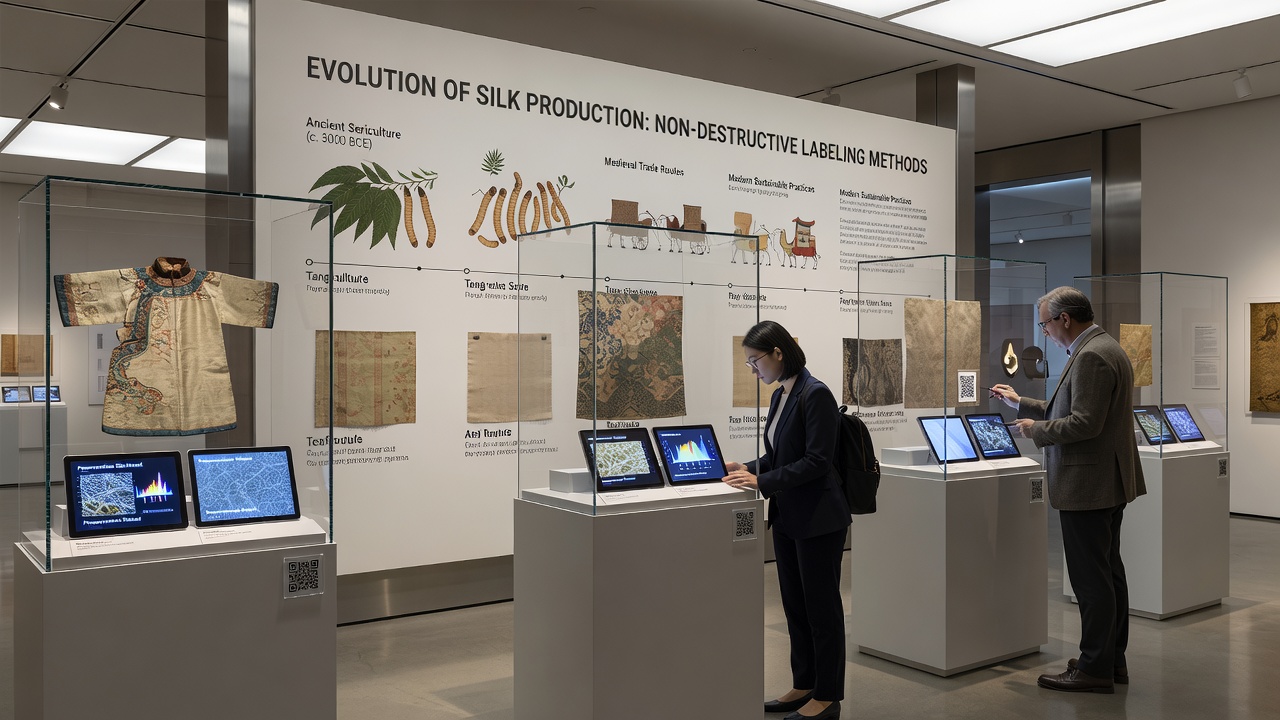
One study conducted at Kyoto University documented how near-infrared spectroscopy combined with invisible barcode systems distinguishes between wild and cultivated silk varieties across centuries of samples. Observers note that this combination supports longitudinal analysis of production changes, such as the introduction of synthetic weighting agents in nineteenth-century French mills, without disturbing the textiles themselves. Additional projects in Australian museums have integrated RFID tags encased in inert materials that attach via static adhesion rather than stitching, allowing real-time inventory updates during conservation work.
Applications in Major Textile Archives and Current Projects
Collections at the Metropolitan Museum of Art maintain databases that cross-reference non-destructive labels with historical trade records, revealing shifts in mulberry cultivation practices that affected fiber fineness during the Ming dynasty. European institutions, including those in Lyon, France, have adopted laser-etched microdots on storage mounts that correspond to individual silk bolts, facilitating comparisons between pre-industrial and industrial era production without repeated handling. These methods support collaborative research across continents, and figures from the Canadian Conservation Institute show reduced degradation rates in labeled samples compared to earlier tagged items.
In October 2026, the International Textile Archive Network plans to launch a unified digital platform that aggregates labeling data from participating institutions in Asia, Europe, and North America. This initiative builds on existing protocols by incorporating blockchain-secured records of each label application, ensuring provenance chains remain intact for pieces spanning multiple production eras.
Conclusion
Non-destructive labeling continues to expand teh scope of historical analysis available to textile researchers, connecting production details across global archives while maintaining the physical condition of silk artifacts. Institutions worldwide now rely on these systems to build comprehensive timelines that document technological transitions without introducing new variables into the preservation process.